The flyer is printed, the website doesn't exist: giving your launch an address
LAUSANNE, Switzerland —
The flyer is printed.
It’s on a bar counter, in a friend’s pocket, in an Instagram story. It carries a date, a venue, a logo, and a web address.
Someone types that address on their phone. They land on a registrar’s “coming soon” page, in a language they can’t read, with a reCAPTCHA and a cookie banner. They close the tab. They won’t find out what it is, who’s behind it, or why they should come.
And the event is three weeks away.
What starting an association actually looks like
This isn’t an invented scene. It’s where most associations, collectives and cultural projects start, and it looks like this:
- The domain name was registered months ago. It cost a few francs and it serves an empty page, because the site builder that came with it needed a weekend nobody had.
- The texts exist. A founder wrote them, proofread them, translated them, in the first person. They sleep in a shared document that only two close friends have read.
- The identity is already there. A logo an illustrator drew, an approved palette, watercolours on a flyer. Everything is ready to be shown, nothing is online.
- Advice was asked for. A friend, a forum, an AI. Out came a list: a 3D globe to spin, insects that appear as you scroll, a five-item menu, a members’ area. And a conclusion: “I’ll need to manage it myself.”
- The date, though, doesn’t move. It’s printed. Every day that passes is a day someone types the address and leaves.
This isn’t a badly prepared project. It’s a project where everything is ready except the one thing people will see first.
It’s paid for in lost visitors. Not in francs, in people who won’t come.
What a launch website really has to do
A launch website has only three things to do. And none of them is “do everything”.
1. It’s online before the date
The full site, with its five pages, its documentary and its form, will come. But not before the event: before the event, you need a page that says who, what, when, where, in ten seconds, on a phone.
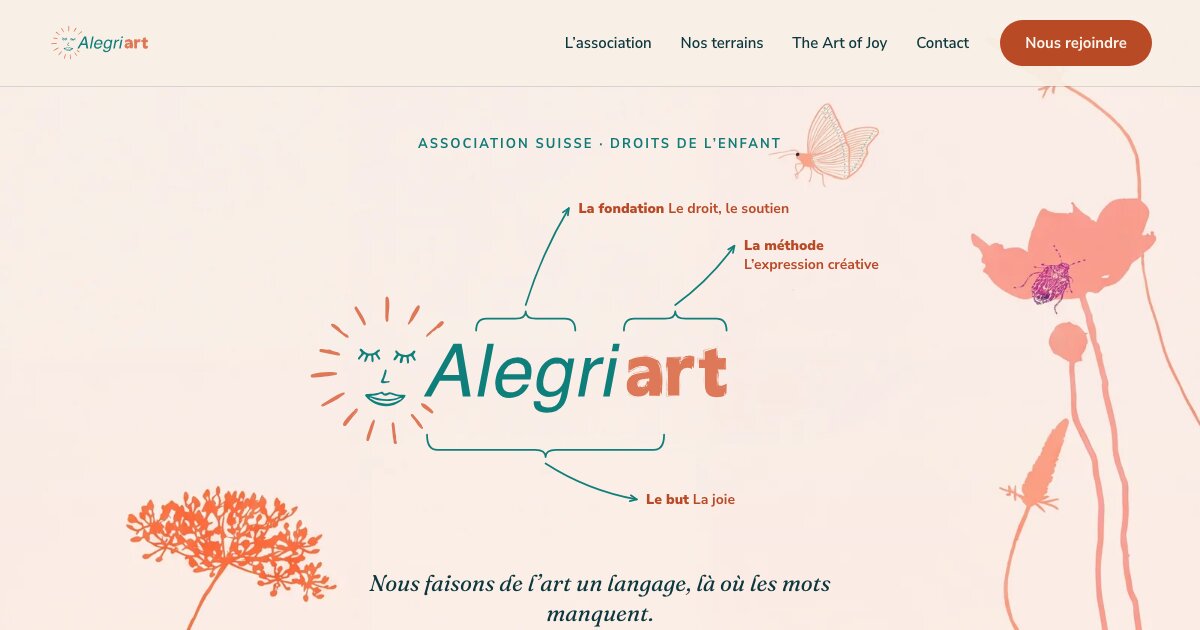
For Alegriart, a Swiss association that brings law and art together for children’s rights, that page went live five days after the brief. One page, two languages, the launch with a button that adds it to the phone’s calendar, the legal notice, HTTPS. The address on the flyer now leads somewhere.
The rest of the site gets built afterwards, calmly, with the feedback from the event.
2. It looks like you, not like a template
An association that’s just starting often has more identity than an established company: a logo that tells a story, hand-made illustrations, a voice.
Alegriart’s site has no stock image, no generated image. The logo is explained on screen the way it is on the founder’s own sketch: law, art, joy, in a single word. The coral plants and the line-drawn insects come from the flyer. The texts are integrated as they are, with their “I”. And what the AI’s advice suggested, the 3D globe, the carousels, the members’ area, was set aside one request at a time: two field locations on a drawn map beat a 200 KB globe that stutters on a phone.
What’s distinctive comes from what you already have. Not from a library of effects.
3. It costs nothing to carry
A website that needs feeding eventually stops being fed. A launch website has to stand on its own.
Alegriart’s has no tracker, so no cookie banner. No JavaScript library: the motion is in CSS, and nothing moves for those who prefer a still screen. No admin panel to learn: the content changes a few times a year, and those changes are delegated. The page loads fast, reads well, and stays current without anyone thinking about it.
What you’re going to say
“We don’t have all the content yet.”
You have more than you think: a name, a date, a venue, a logo, and probably three sentences that say why you exist. That’s the launch page. The five pages of the full site wait for the missing content; the launch doesn’t.
“I’ll have to manage it myself.”
Not necessarily. An association that changes its site twice a year doesn’t need to learn an admin tool. It needs someone to write to. The day updates become monthly, the tool gets set up, not before.
And your launch
Nothing that was done for Alegriart is specific to Alegriart. A collective with a flyer, a domain serving an empty page and texts in a shared document has exactly the same address to give.
So, one question: what’s the date on your flyer?
A full website waits for you. A launch page goes ahead of you.